contrapasso III
on Dante's Divine Comedy: Ring VII

Welcome back everyone. Did you miss me? I sure as Hell missed you.
Last night we left off our descent into the Underworld at the Sixth Ring of Hell. There are three rings left for our duo to discover.
After Dante’s personal enemies encountered in the River Styx and the Sixth, I began to feel slightly discombobulated in regards to the identity separation between poet and protagonist. It is becoming inherently more difficult to discern the difference between art, and artist—perhaps because the subject matter deals so mercileslly with morality, one would assume the storyteller would be a deity or morally superior individual or even an Angel—but maybe that is precisely Dante’s insane genius. Should we actually be trusting our narrator to describe each layer of Hell if he himself is simply filling the space with his own enemies? Could he be trusted as a narrator if the journey is really more of a personal fantasy rather than an unbiased portrayal of theological reality? Could it even be said that Dante was writing a manifesto on revenge and vindication á la Count of Monte Cristo, which in and of itself goes against the eligibility of his ultimate ascent into Paradise?
“Dante is here viewing sin through an Aristotelian lens, we have to take a further step and state clearly: the ideological system adopted for this section of a Christian hell is not Christian.” —Commento Baroliniano, published in partnership with Columbia University
But, more on my personal feelings about Alighieri later.
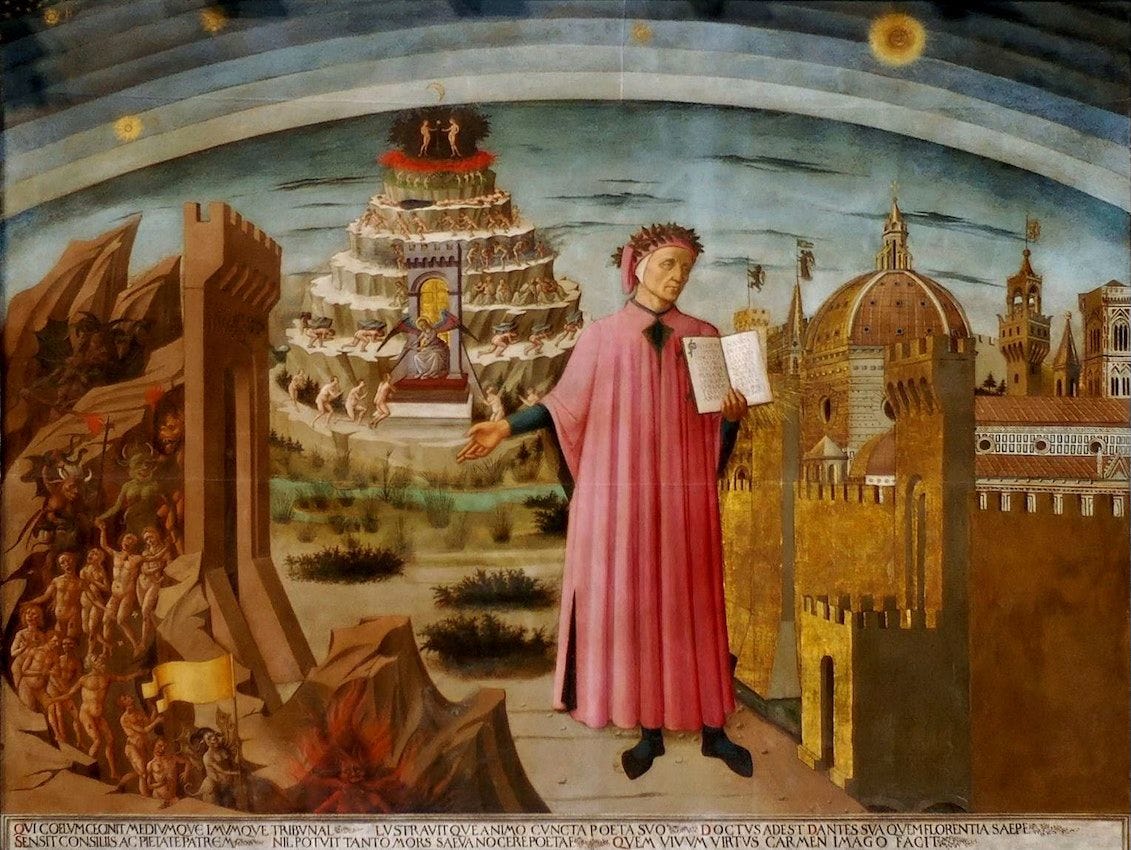
The Seventh, also known as the circle of Violence, is divided into three subdivisions. The first, is reserved for those who commit violence against others. The second, violence against the self. Last, for those who were violent against God, Nature, and Art. This specific ring is guarded by an angry and self-eating Minotaur, who was himself a spawn of violence and war, according to Greek mythology. It is important to recognize that the structure of the Violence realm rings are growing inward, rather than concentrically outward. It leads a reader to think that the realms are becoming more concentrated, smaller, and closer to the crux of Hell.
The first subdivision illustrates a river of boiling blood called Phlegethon where all earthly murderers, warlords, and tyrants are submerged into varying depths based on how much violence they themselves committed. The famed tyrants such as Alexander the Great and Attila the Hun are drowning in hot blood up to their eyebrows. Centaurs patrol the bloody banks with bows and arrows, shooting anyone who tries to rise higher than their sentence allows. It’s one of Dante’s most creative mechanical punishments; the depth of blood equals the depth of guilt. Perhaps Ted Bundy is being boiled alive next to Mussolini in this ring of bloody punishment. I would name some people who currently deserve a dunking into the Phlegethon that haven’t yet reached decay but doing so might get me deplatformed.
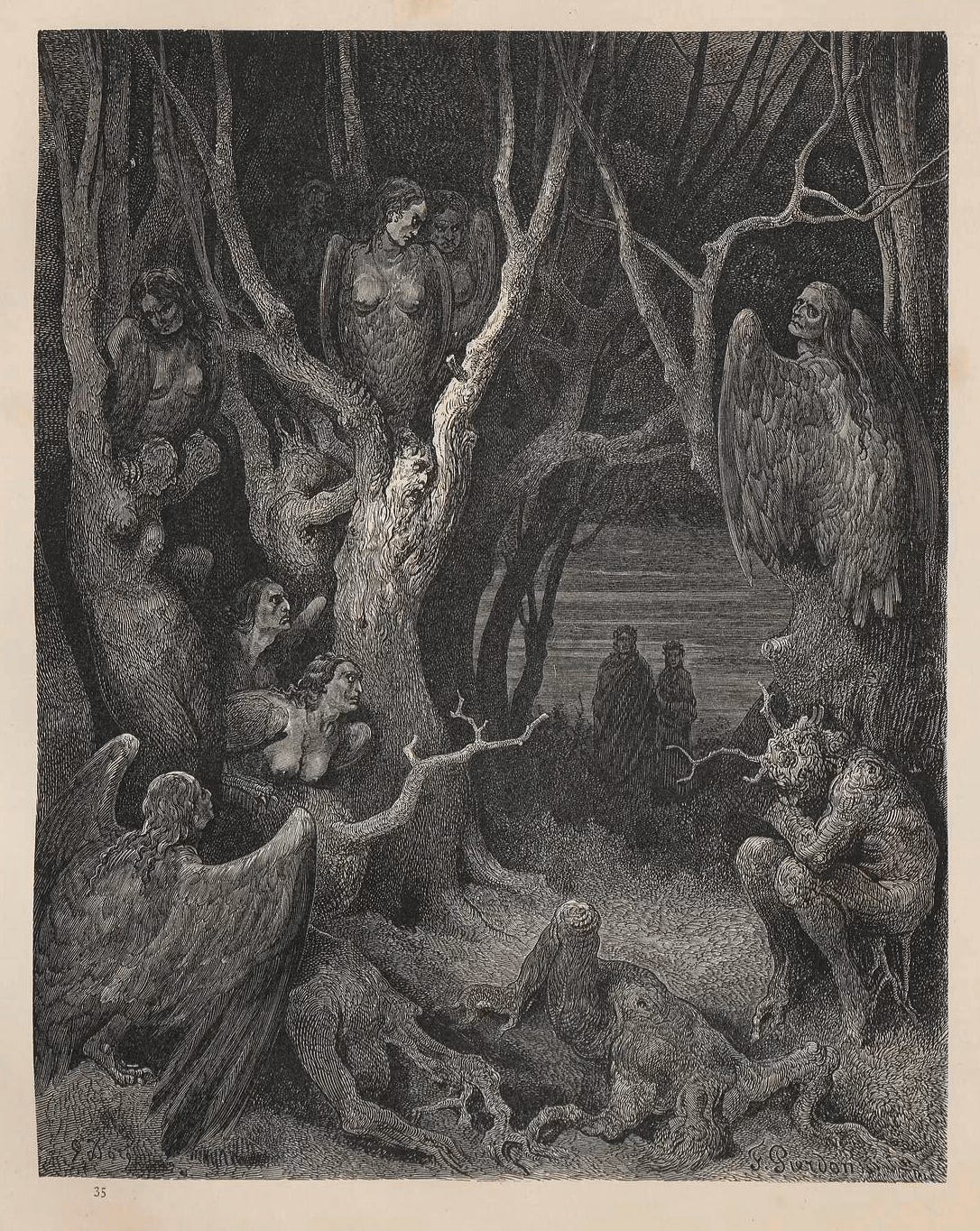
The second division, as previously stated, is reserved for those who have harmed themselves—profligates also exist amongst this realm, somehow worse off than those who have committed prodigality, avarice or gluttony—and Dante’s allegorical depiction of this place is genuinely terrifying. Those amongst this realm have been turned into thorny gnarled trees instead of keeping their human bodies. Dante’s reasoning is that since on earth, the sinned have chosen to betray their bodies, similar replication of torture should be emulated in Hell, but without permission or warning. The trees are also tormented by Harpies that nest in them and feed on their leaves, creating wounds through which the souls can speak, only to then swiftly close again. At the resurrection, these souls can never reunite with their own bodies, because they willfully rejected them. Their bodies will hang on their own branches, permanently estranged from themselves. Some of the poem’s most piteous and melancholic passages are written about The Forest of Suicides. Seeing as Dante did not know the trees were former humans until Virgil asked him to break off a branch, causing this particular tree to bleed and scream. Unbeknownst to Dante, this was someone he knew of on Earth, identifying himself as Pier della Vigna, a powerful minister of Emperor Frederick II who fell out of favor and promptly chose to kill himself in prison.
“Harpies are found in Canto XIII of the Inferno, roosting in the Seventh Circle, in the Wood of the Self-Murderers. Here they guard, and eat, the people who have either attempted or committed suicide, resulting in their painful transformation into twisted, thorny, bleeding trees. The poem describes them as, "Wide-winged birds and lady-faced are these / With feathered belly broad and claws of steel; / And there they sit and shriek on the strange trees." (Inferno:XIII, 13-15)”
“In the Divine Comedy their role is to cause agony, feeding on the shoots and leaves sprouting from the suicides. Though distressing, the anguish they cause is nevertheless needed by the trapped souls: crying out in physical pain is the only way in which they are allowed a voice. Having expressed their grief by destroying their bodies, they are denied expression in death. Allegorically, just as the trees represent a misshapen mockery of the body they rejected in life, so too do the harpies who live in their branches. The relationship between the two is not lost in Dore's engraving below: the outstretched tree limbs in the lower left are a visual extension of a harpy's wing, and the faces and forms of the creatures are consistently elided with the forest, making the torturer and tortured appear one and the same - an apt allegory for self-hatred.” —Archives and Special Collections, The University of Melbourne
The last ring of Violence, subdivided by three different types of sinners, exists as a plain of scorching sand beneath a rain of methodically slow flames. The sodomites, usurers, and blasphemers share this domain, with varying different forms of torture. Blasphemers lie on their backs in the sand, staring up into the fire falling on them, defiant and rebellious. The most prominent is Capaneus, a figure from Greek myth who raged against Zeus while dying and now continues to rage against God in Hell. Dante is almost perversely impressed. Virgil is not. The Sodomites must keep running laps constantly without rest, for once a sinned soul stops, they are forced to lie down in the scorching sand for 100 years. Dante meets his beloved mentor Brunetto Latini here, and the encounter is one of the most emotionally complex in the poem; they walk alongside each other, Dante above on a raised embankment and Brunetto below, and they speak with tender love and mutual respect. Dante calls him the man who taught him how to make himself eternal through writing. There is such obvious affection between the two, though cruelty strips Brunetto from the conversation and back to the group of skipping sodomites.
I have had the inclination to suspect that, it could be possible Dante Alighieri was curious about his sexuality. Repressed, even? Robert Pogue Harrison of Stanford University seems to echo my own instincts.
“In “Dante on Trial” (New York Review of Books, Feb. 19), Robert Pogue Harrison writes, “Dante seems to reveal that he himself had homosexual leanings, and that it was only fear of damnation that prevented him from acting on them.” This surprised me because Dante seems never to be claimed as a gay writer (Google finds no such assertions), and his denunciations of “sodomy” are rather famous. But here is the relevant passage from Canto XVI (lines 46-51), in my translation:
If I had been shielded from the fire
I’d have thrown myself down there with them
And I think the master would have let me.But since that would have burned and baked me,
My fear overcame my good desire
That made me so greedy to embrace them.*So says Dante when he observes the men punished for sodomy, naked and oily and trying to grasp one other under a rain of fire. His master, of course, is Virgil; and it appears that the Roman poet would have allowed [sofferto] Dante to embrace these men as he wishes.” —Peter Levine, Associate Dean of Faculty and the Lincoln Filene Professor of Citizenship & Public Affairs in Tufts University’s Jonathan Tisch College of Civic Life.
See what I mean about this slowly turning inward, and mirroring Dante’s own personal reflection? Placing homosexuals beneath murderers seems like a repugnant way of admitting guilt and admonishing acceptance of such common human emotions. Those who banish and show prejudice to homosexuality seem so ferociously against such behaviors and tendencies that one can only assume it’s because of an internal hatred of one’s own desires and self. I question our narrator more as we descend, wondering if Dante is truly a genius to be emulated and shown reverence to; or if he was just another closeted gay man, trying to rationalize hurting the world because it somehow hurt him first. Spewing such elaborate condemnation and judgement, as though he himself is a deity or demi-god; one could assume that the narcissistic and egomaniacal manifestations of Dante showcase themselves more than we can imagine, when read from a lens of questioning scrutiny.
Was Dante Alighieri, a gay genius?