

contrapasso II
on Dante's Divine Comedy: Rings V-VI

If you have been following along on my journey into the bowels of Hell through Dante Alighieri’s Divine Comedy, I must advise against going any further. The following is even more gruesome and grim than my first installment of analysis.
“Through me you go into a city of weeping; through me you go into eternal pain; through me you go amongst the lost people…All hope abandon, ye who enter here” —Dante’s Inferno
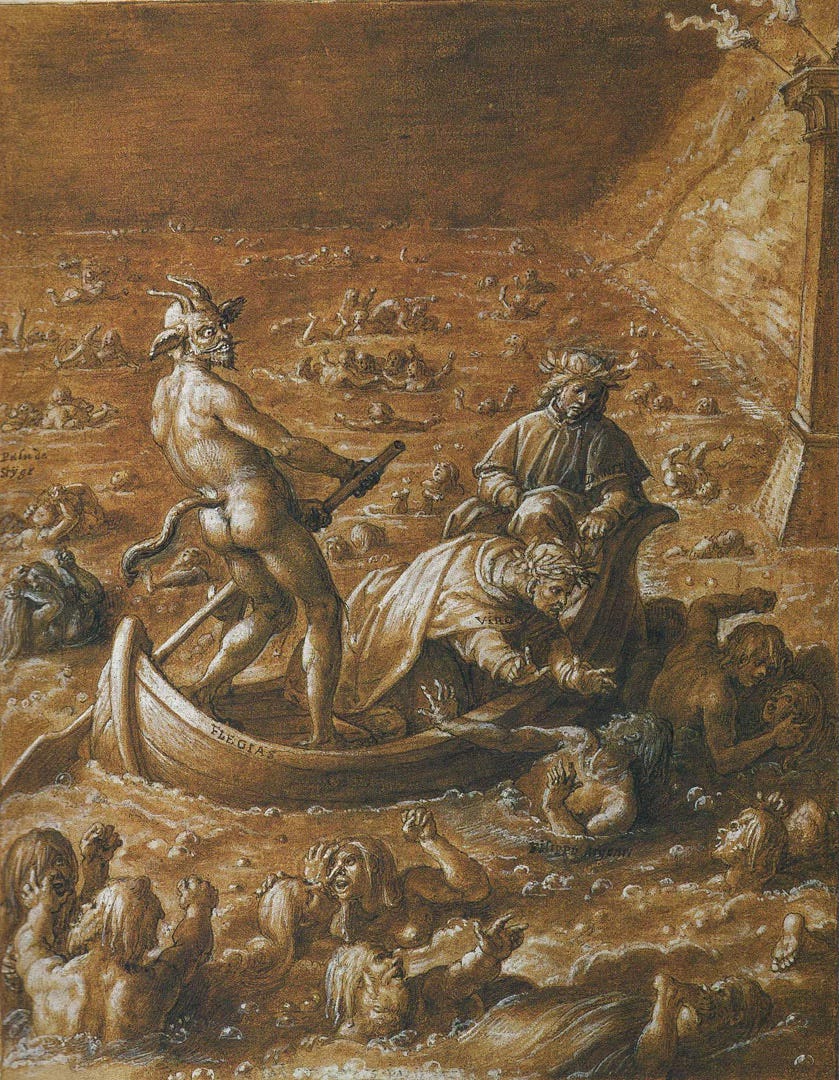
Welcome to the Fifth Ring of Hell, otherwise known as the impossibly odorous swampland of Wrath. The Fifth specifically punishes two intertwining sins: wrath and sullenness. The wrathful are above the toxic waters, ripping and chewing each other to pieces with no resolution in sight; they exhibit and indulge in violent urges with zero resolution. As they have behaved on earth with the same insolent retribution, their mannerisms and tastes are continuously echoed in Hell. The sullen have a much crueler fate, as they are ingesting, breathing and living beneath black bile. Though obstructed to the naked eye, the condemned scream and wail incessantly whilst suffocating, unable to utter cognitively recognizable sentences or find footing above the darkness. In life, the sullen repress their emotions, nursing internal bitterness like a depraved pet of decomposing resentment, rather than participating in the meaningful vitality and continuous direction of civilized humanity. They "sulked in the sweet air made glad by the sun," as Dante once mused. So, in Hell they are literally smothered and sunken in belletta negra (black mud) for all of eternity. This realm is largely defined by the River Styx, one of the greatest rivers in Hell; a neverending, terrifyingly grotesque, foul-smelling marshland (Washington D.C.?). Dante and Virgil cross it by boat, ferried by the impetuous shortfused former god and current demonic employee Phlegyas.
“The infernal employee who transports Dante and Virgil in his boat across the Styx (Inf. 8.13-24)--circle of the wrathful and sullen--is appropriately known for his own impetuous behavior. In a fit of rage, Phlegyas set fire to the temple of Apollo because the god had raped his daughter. Apollo promptly slew him. Phlegyas, whose own father was Mars (god of war), appears in Virgil's underworld as an admonition against showing contempt for the gods (Aen.6.618-20). Megaera, one of the Furies, tortures a famished and irritable Phlegyas in Statius' Thebaid (1.712-15).” —Dantesworld, The University of Texas at Austin
For those of us trying desperately to categorize in our minds who supposedly belongs where in each ring of hell, don’t worry; we’re all going there. Every single loop of sin is a baser human instinct, and Dante specifically has written it as so to describe and encapsulate all of humanity. Perhaps in ring five, I nominate myself. Myself when in the luteal phase, myself when triggered, myself when I drive poorly, myself when arguing, myself when digesting useless content, myself when reading political think pieces, myself when learning history, even myself as I fucking write this. Maybe me and Phlegyas can strike a lucrative partnership deal and play cards whilst we ferry the future damned, but I digress. It’s also written in the novel that Dante comes across his real life nemesis Argenti desperately seeking rescue, but callously chooses to let him drown in the River Styx. Though Virgil praises his vengeful spite, it illustrates that even our narrator perhaps is an unreliable moral voice, much less one of impartial reason and potential divinity.
The Sixth Circle is the first of Lower Hell Proper; reserved for the Heretics, it displays a distinct shift in the nuances and natures of sin. Heresy is a sin not of uncontrollable passion or voracious appetite but rather of cognisant intellect, specifically those who wholeheartedly denied the immortality of the soul in relation to the Church and teachings of Jesus Christ. In Dante's framework, these are the possible genius thinkers who rejected theological truth through academic arrogance and willful disbelief. There's an almost tragic grandeur to the souls within this realm. Prideful, brilliantly intelligent, and completely unrepentant. Though I have been wary of our narrator’s motives and internal monologue since the River Styx encounter, the Sixth feels slightly like a repudiation of Dante’s own faults. Dante was after all, a White Guelph, ultimately proposing to reject papal interference in Florence, leading him to perpetual exile, which unceremoniously contributed to his fated descent into the Inferno. But perhaps this explanation is exactly heresy, and attributing speculation in such a manner is what could possibly lead to a life spent within the Sixth Circle.
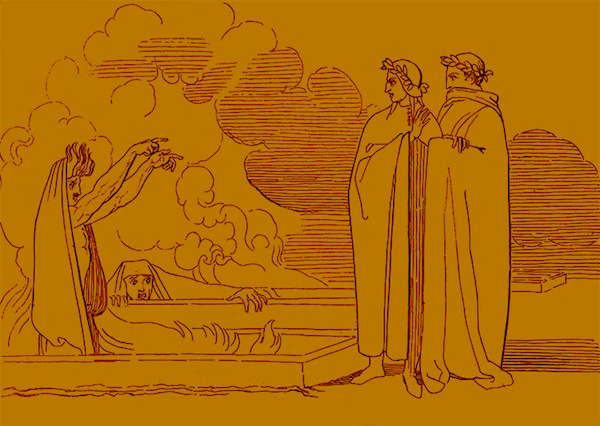
In the Sixth, punishment is served with twisted irony; sinners denied the soul’s afterlife, so they must have an afterlife, but only one of eternal entombment. They are buried alone in flaming graves, fully awake and eternally suffering. The souls in this circle can somehow also see the future but not the existing present, so they prophesize without true knowledge, abstract and empty in their manifestations. Again, we have somehow veered away from the myriad of famous faces and now only proceed to meet Dante’s personal foes, though it has been mentioned that Pope Anastasius II and Emperor Frederick II are some of the Sixth’s residents.
Is it just me?
Or are you also beginning to slightly distrust our narrator?
Why are the deepest bowels of Hell only reserved for his own enemies?
Why is it so distinctly unnerving that he himself, as the bitterly exiled, is writing an allegorical poem depicting faint revenge cosplay on a gargantuan and cosmically large scale? The Argenti/River Styx scene specifically leaves a reader in disbelief at the cruelty exhibited by Dante; not only does he not aid in Argenti’s pleas, but Dante even asks for more suffering.
Could it be that Dante is to martyrdom, as Walter White is to heroism?